Quick Share is a wireless file transfer feature from Samsung and Google that allows users to quickly share files between devices via Wi-Fi and Bluetooth. First introduced as a Samsung-exclusive feature with the Galaxy S20, it was integrated with Google’s Nearby Share in January 2024 and has since become the standard sharing solution across the Android ecosystem, supporting not only Samsung devices but also other Android devices, Windows PCs, and Chromebooks.
Quick Share is also compatible with Apple’s AirDrop. Starting with the Pixel 10 series in November 2025, Google began rolling out two-way AirDrop compatibility to Android devices, and Samsung followed in March 2026 by officially adding AirDrop support to the Galaxy S26 series running One UI 8.5, beginning in South Korea.
As Quick Share expands its support across a wider range of devices and operating systems, its importance from a digital forensic perspective is increasing. Quick Share records are more than just a history of file transfers—they can act as key artifacts revealing a user’s send/receive activity and the connections between devices. Information on shared files, connected devices, and the use of the ‘Private Sharing’ feature can be particularly valuable for identifying data leaks, the movement of evidence, or the transfer of materials between accomplices.
This article explains how to share data with iOS and Android devices using the Quick Share feature, and the information that can be collected from an Android device after sending or receiving content via Quick Share. The findings are based on data extracted from an Android 16 device via MD-NEXT v2.2.14 and analyzed via MD-RED v4.0.12.
Table of Contents
How to Use Quick Share
To share content using Quick Share, both the sending and receiving devices must have Wi-Fi and Bluetooth enabled, and devices must be located within nearby range. To share content with Galaxy devices, you must be signed into a Samsung account. To share content with non-Galaxy devices, a Google account sign-in is required.
Sharing with Nearby Devices
Sending Content
- Select the content to share, then tap the Share
 button.
 - Tap the Quick Share
 button.
 - Select the user or device to share the content with. The available sharing targets may vary depending on the receiving device’s Nearby Sharing settings.

Receiving Content
When a Quick Share request is received, a sharing notification appears on the receiving device. The recipient can preview the type of content being shared and choose whether to ‘Accept’ or ‘Decline’ the request.


Private Share
Private Share is a secure sharing mode available between Galaxy devices. It allows the sender to set an expiration time for shared files. By default, the expiration period is set to 2 days, and it can be extended up to 6 days, 23 hours, and 59 minutes. Recipients cannot take screenshots, save, or reshare the shared content, and the files are automatically deleted after expiration.
Sending Content
- Select the content to share, then tap [Turn on Private Sharing].
- Set the expiration date, then select the user to share the content with. The available sharing targets may vary depending on the receiving device’s Nearby Sharing settings.

Receiving Content
When a Private Share request is received, a notification appears on the receiving device. The recipient can preview the type of content being shared and choose whether to ‘Accept’ or ‘Decline’ the request.

Available Information from Mobile Devices
The linkShare.db file stores records of files sent and received through Quick Share, the target devices involved in sharing, and the sharing timestamps. The privacy_library_database.db file stores records of content sent and received through the ‘Private Share’ feature.
The table below summarizes the information above.
| DB | Table | Available Information |
|---|---|---|
| linkShare.db | devices | Connected device name, timestamp |
| transfer_file | List of sent files | |
| receiving_file | List of received files | |
| privacy_library_database.db | FileLogCard | Records of files sent or received through Private Share |
Summary
- Quick Share is a wireless file transfer feature jointly provided by Samsung and Google. It enables users to share data not only between Android devices, but also with devices running other operating systems, including Windows, iOS, and macOS. Support for iOS and macOS transfers is currently limited to certain devices and OS versions, but is gradually expanding.
- Quick Share supports both Nearby Device Sharing and Private Share. Records of these sharing activities are stored in
linkShare.dband the Private Share-specificprivacy_library_database.db. Analyzing these records can reveal details about sent and received content, target devices, and sharing timestamps.
Appendix
Quick Share Receiving Settings
The available sharing targets may vary depending on the receiving device’s Quick Share settings.
- No one: No one can share content with the device.
- Contacts: Only users saved in Contacts through a Samsung account can share content with the device.
- Everyone: Anyone nearby can share content with the device.
For more information, please refer to https://www.samsung.com/us/support/answer/ANS10007268/.
Supported File Types by Sharing Method
Quick Share supports different file types depending on the sharing method.
- Sharing with nearby devices: No restrictions on shareable file types
- Sharing using QR code or contacts: Some file types are not supported, such as exe, com, bat, cmd, vbs, reg, msi, etc.
- Sharing using Private Share: The following file types are supported.
- Image: jpeg, jpg, png, gif, bmp, webp, heic, dng
- Video: webm, mp4, 3gp, 3g2, mkv
- Audio: mp3, wav, ogg, m4a
- Document: txt, pdf
File Transfer Limits by Sharing Method
Quick Share has different file count and size limits depending on the sharing method.
- Nearby device sharing: No restrictions on file count or total transfer size.
- QR code and contact sharing: Up to 1,000 files per transfer, with size limits of 10 GB per file and 10 GB per day.
- Private Sharing: Up to 20 files and 200 MB per transfer.


 icon in the bottom right corner of the app to see the categories of data that can be recorded in the Health app. For more details, refer to
  icon to manually input the data.
 icon to save.









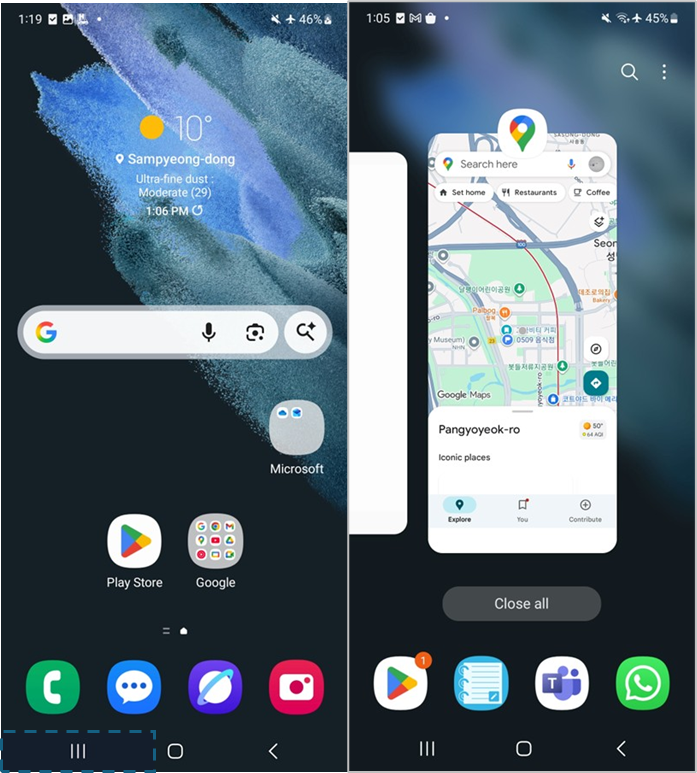
 at the bottom-left of the home screen to access the ‘Recent Apps’. Swipe left or right to browse through the apps running in the background. You can reopen a specific app or swipe it upward to remove it from the ‘Recent Apps’. Up to 50 apps can be open in the background, and when the limit is exceeded, the oldest apps will be removed from the ‘Recent Apps’.